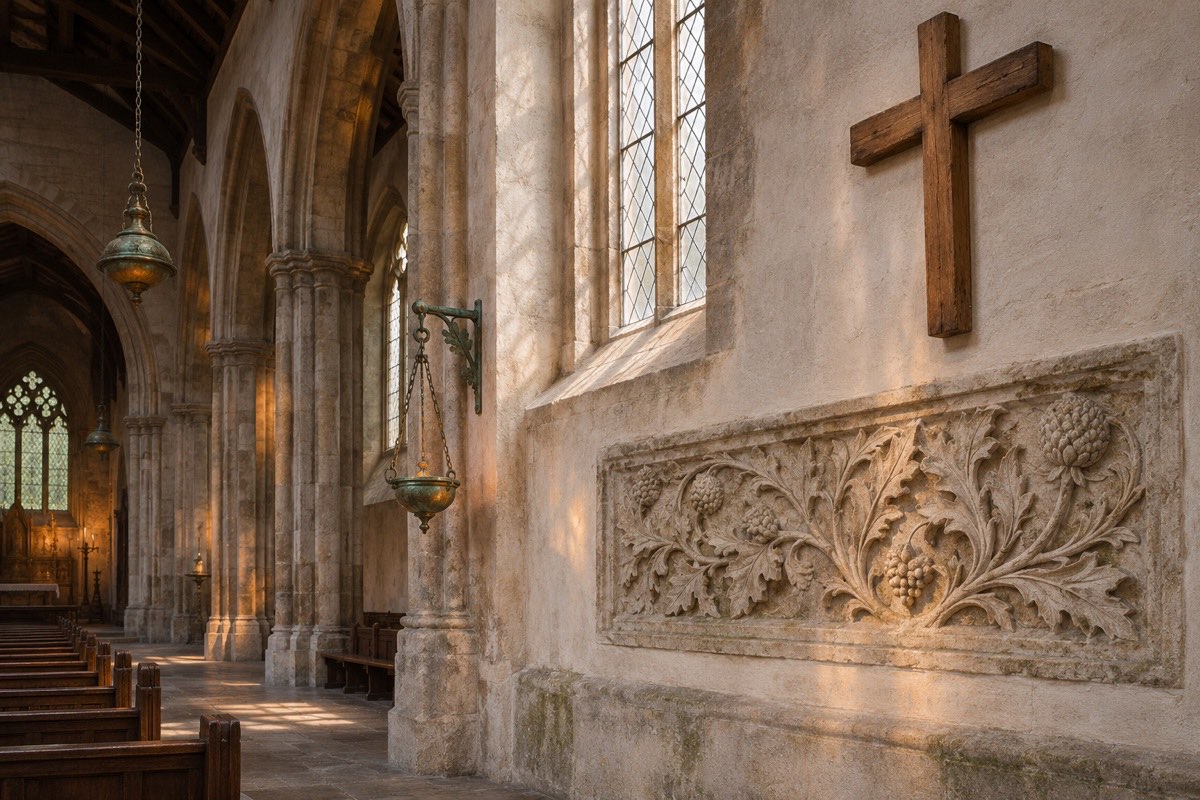
Liturgical sculpture: forms and purpose of sculpture in the church
Liturgical sculpture is made for worship and church spaces. Why do churches contain figures, crosses and reliefs, and how do these differ from works in a gallery? This article explains the basic terms, describes the main forms of church sculpture and traces its changing role over the centuries.
Liturgical sculpture definition
Liturgical art is defined partly by its function: it provides objects and places for worship during the liturgy. The same principle applies to liturgical sculpture. What matters is both its appearance and its role in worship. Because of this sacred function, liturgical objects were often made from the most precious materials.
Sculpture has played an important role in religious worship for centuries. Until recently, large sculptures were too costly for private individuals and usually expressed religious or political ideas. Sculpture became particularly important in Christianity and Buddhism, while the Orthodox tradition never accepted monumental sculpture. The presence of figures in churches therefore depends partly on each denomination's traditions.
Crucifix and corpus
Sculpture in Catholic churches takes several recurring forms. One is the crucifix, a cross bearing an image of Jesus. The figure on the cross is called the corpus. The crucifix is especially important in the Catholic Church, but Lutherans and Anglicans also use it. In the West, the corpus is usually three-dimensional. In the Orthodox tradition, it may be painted or made in flat relief.
A large crucifix suspended along the central axis of a church is called a rood in English. This arrangement was almost universal in the late Middle Ages. Today it is rare, and contemporary Catholic churches often place a crucifix on the wall above the altar.
Stations of the Cross
The Stations of the Cross are usually a series of fourteen depictions of the day of Jesus's crucifixion. They typically take the form of small plaques with reliefs or paintings arranged around the nave. The devotion is most common during Lent, especially on Good Friday. Contemporary minimalist stations sometimes consist of simple numbered crosses.
Altarpiece, reredos and tympanum
The retabulum, also called an altarpiece, is a painting or sculpture, including relief, depicting a religious subject and placed behind the altar. The entire structure behind the altar is called a reredos. Altarpieces became common from the 11th century. From the late Middle Ages to the Baroque, they were among the most important works of Christian art.
The tympanum is a semicircular or triangular surface above an entrance, bounded by the lintel and arch and often decorated with sculpture. It is associated mainly with Romanesque and Gothic architecture.
A short history of church sculpture
The oldest Christian sculptures are small reliefs on Roman sarcophagi from the early 2nd century. Freestanding sculpture was long avoided because of its association with pagan statues. Only in the Carolingian and Ottonian periods did monumental statues begin to be made in the West for courts and major churches. In the Gothic period, sculpture expressed the suffering and fervor of the Christian faith. In the 12th century, the tympanum above a church door became a new place for sculpture. From the Renaissance, church sculpture moved mainly indoors, while public monuments became common outdoors.
Dioceses today publish their own guidelines on commissioning, buying and accepting liturgical art. A work is expected to be worthy of a place of worship and to support the liturgy, prayer and contemplation.